

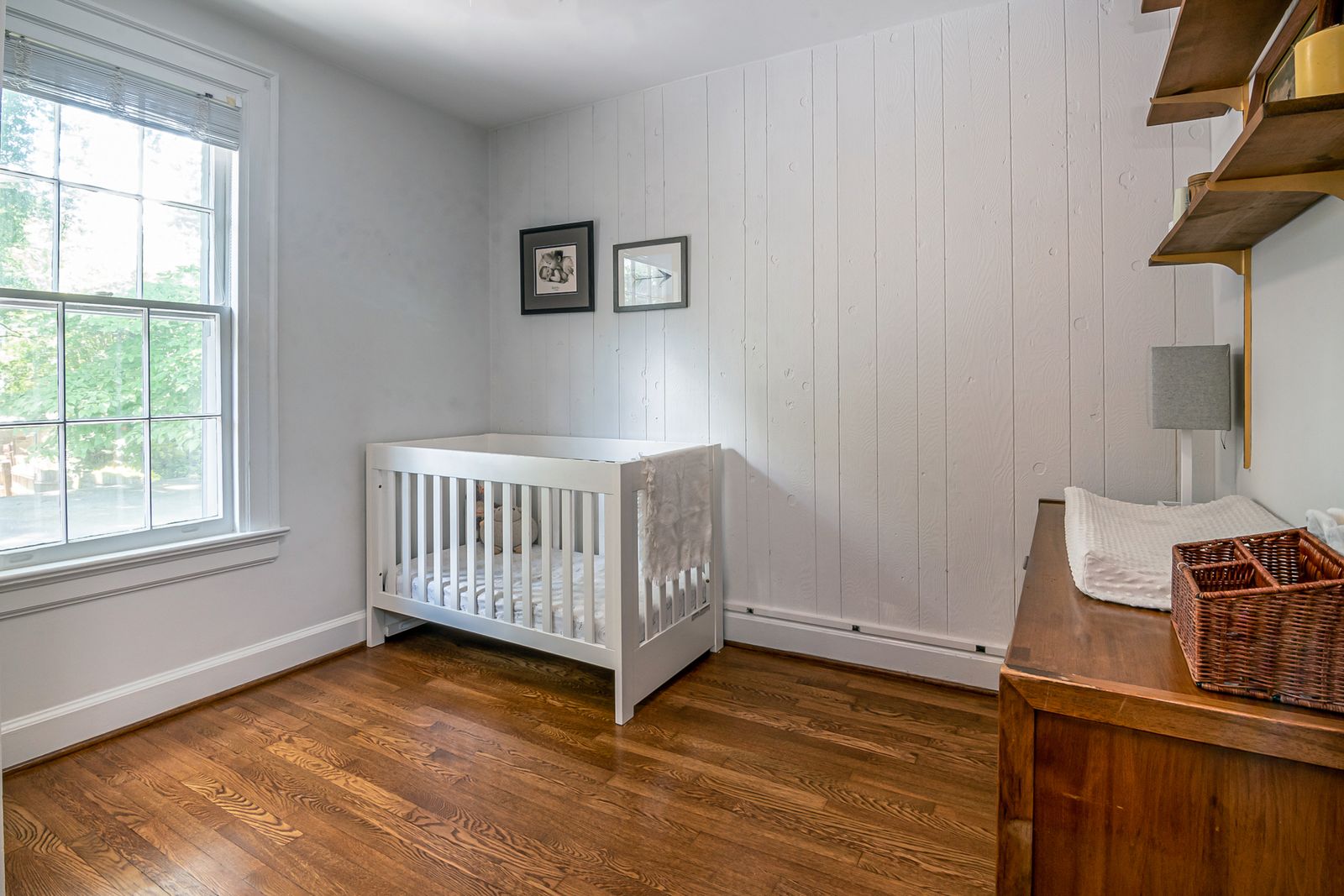
Nursery paint colors set the backdrop for a room that changes fast, from the newborn months to a toddler's bedroom. The colors that last are the ones that still work in low light and as the child grows, such as soft whites, warm grays, muted blues and gentle greens.
At Paintzone, we offer interior painting in Seattle for homes and businesses, and we are a certified lead-safe firm.
Which nursery paint colors work best, and what makes each one work?
When you compare nursery colors, look at the Light Reflectance Value (LRV) next to the name and code. Sherwin-Williams defines it as a 0 to 100 measure of how much light a color reflects, so the higher the number, the brighter a color stays in a dim room.
Soft whites and warm neutrals that keep a small nursery feeling bright
Whites and greiges reflect the most light, so they suit a north-facing or tree-shaded nursery and go with any bedding or furniture.
- Benjamin Moore Cloud White OC-130, LRV 85, a soft, balanced white
- Sherwin-Williams Alabaster SW 7008, LRV 82
- Sherwin-Williams Shoji White SW 7042, LRV 74
- Benjamin Moore Pale Oak OC-20, LRV 69, a neutral with warm gray undertones
- Sherwin-Williams Agreeable Gray SW 7029, LRV 60
Muted blues and blue-grays for a calm nursery that grows with a child
Lighter blues and blue-grays keep a nursery bright on every wall, while a deeper blue such as Adrift works better on a single wall.
- Benjamin Moore Breath of Fresh Air 806, LRV 69, a light blue
- Benjamin Moore Wickham Gray HC-171, LRV 68, a blue-gray
- Sherwin-Williams Upward SW 6239, LRV 57
- Sherwin-Williams Adrift SW 7608, LRV 37, a mid-blue
Soft greens with gray undertones for a nature-inspired nursery look
Greens with gray in them bring color into a nursery without turning bright, and the deepest of them belongs on an accent wall or on furniture.
- Benjamin Moore Healing Aloe 1562, LRV 68, a green with notes of gray
- Sherwin-Williams Sea Salt SW 6204, LRV 63
- Sherwin-Williams Rosemary SW 6187, LRV 14, a deep green
Blush pinks and soft violets for a warm nursery without bright pink
For warmth without a saturated pink, a muted blush or a grayed violet keeps the walls soft.
- Sherwin-Williams Romance SW 6323, LRV 66
- Sherwin-Williams Veiled Violet SW 6268, LRV 47
What makes a nursery color gender-neutral, and which shades qualify?
A gender-neutral nursery color is one that reads as neither pink nor blue, such as whites, warm grays, greiges, soft greens and muted yellows. Pale Oak, Agreeable Gray, Healing Aloe and Sea Salt all fit, and they carry over into a child's bedroom later as the furniture and decor change.
How does room light change nursery paint colors in a small bedroom?
In a small bedroom, the light the room gets decides how a nursery color looks on the wall. Since LRV measures how much light a color reflects, a high-LRV color keeps the walls from closing in when there is only one window, while a low-LRV color makes them read darker.
That matters in Seattle, where Sea-Tac averages 226 cloudy days a year, according to the Western Regional Climate Center. A color chosen on a bright day will look darker for most of the year, so it is worth judging samples on a gray afternoon and again under the lamps you use at night.
How do you paint a nursery safely, and how early should it be done?
The safest plan is to finish the nursery early enough for the room to air out before anyone sleeps in it. Long-standing guidance from the EPA and the Consumer Product Safety Commission recommends keeping the windows open for about 2 to 3 days after painting, and keeping young children and anyone with breathing problems out of the freshly painted room during that time.
If you are expecting, the same guidance says pregnant women should avoid painting projects and limit their time in freshly painted rooms, especially when oil-based paints are used. That makes the nursery a good job to hand to someone else.
The paint itself makes a difference too. Water-based paints emit fewer chemicals than oil-based ones, according to the same guidance, and some go further. Paints certified GREENGUARD Gold by UL have to meet stricter limits on the chemicals they release into the room once they are dry, and UL calls it the optimal certification for products used in nurseries and schools. Sherwin-Williams Emerald Interior is one paint that carries it.
You may also see "zero VOC" on a can, and the two labels are easy to mix up. VOCs, or volatile organic compounds, are chemicals that evaporate from paint. Zero VOC describes what is in the can, while GREENGUARD Gold limits what the paint gives off once it is on the wall.
In an older house, lead is the other thing to check. If your home was built before 1978, it is more likely to have lead-based paint, the EPA says, and scraping or sanding that paint creates lead dust. Children six and younger are the most susceptible to lead. A contractor whose work disturbs lead paint in a pre-1978 home must be a certified lead-safe firm, and in Washington those firms are certified by the Department of Commerce. Paintzone is certified, and on a house built before 1978 we test for lead before sanding.
Which nursery colors are best avoided, and for what practical reason?
In a small nursery, the colors to keep off most walls are the very dark ones, such as Rosemary or other deep greens and navies with an LRV in the teens or lower. They absorb most of the light a small room gets, so they work better on one accent wall or on furniture than on all four walls.
Accent walls, paneling and finishes that add color to a nursery wall
An accent wall lets a stronger color sit on one wall while the others stay light. Paneling or board and batten painted a shade darker than the walls adds depth without changing the room's color, and specialty finishes such as Roman clay and limewash add texture. Placing an accent wall follows the same rules in a nursery as in a living room.

Nursery paint questions parents ask before the room gets painted
Can a newborn see the color of the nursery walls in the first weeks?
Newborns do not see wall colors clearly at first. The American Academy of Pediatrics says they see best at 8 to 12 inches away and get better at seeing colors and shades by about 4 months.
Does a nursery need high-contrast or black-and-white walls for a baby?
A nursery does not need high-contrast walls. The AAP notes that babies show interest in patterns such as bull's-eyes and spirals, and its guidance on infant vision does not cover wall color.
Sources
- American Academy of Pediatrics, Infant vision development: what can babies see?, updated November 2024
- EPA and CPSC, Healthy Indoor Painting Practices (EPA 744-F-00-011)
- EPA, Volatile organic compounds' impact on indoor air quality
- EPA, Protect your family from sources of lead
- Washington State Department of Commerce, Renovation, Repair and Painting
- UL, GREENGUARD certification
- Sherwin-Williams, Emerald Interior Acrylic Latex Paint
- Sherwin-Williams, LRV and color by room orientation
- Western Regional Climate Center, average cloudy days per year
- Color codes, LRV and swatch colors from Sherwin-Williams and Benjamin Moore color data, linked in the color lists
- Photos: Curtis Adams on Pexels and Pixabay on Pexels
We may use AI tools to help draft and edit our articles, and we check every fact before we publish. If something looks wrong, please write to us at contact@paintzonellc.com.